
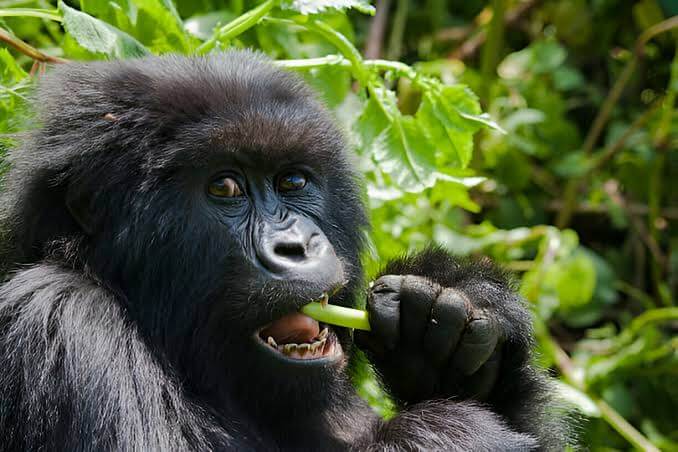
What do Gorillas Eat? Gorilla Feeding Habits & Diet
What do Gorillas Eat? When you look at a silverback gorilla weighing up to 400 pounds with muscles that can effortlessly snap branches, it is easy to imagine them as fierce apex predators. Yet, these massive primates are primarily peaceful vegetarians.
Gorillas spend nearly half of their waking hours eating. To sustain their immense bodies, they have evolved highly specialized diets and digestive systems that allow them to process massive volumes of plant matter.
However, “gorilla” is not a single category; across different regions of Africa, varied habitats dictate vastly different menus.
This comprehensive guide explores exactly what gorillas eat, how their diets change by subspecies, how much they consume daily, and how they find food in the wild.
Best Uganda Gorilla Safari Tours
- 3 Days Uganda Gorilla Trekking Safari
- 4 Days Rwanda gorilla and Lake Kivu tour
- 4 days Bwindi gorilla and wildlife safari
- 4 days Lake Mburo and Bwindi Tour
- 4 days fly in Bwindi gorilla safari
- 5 Days Uganda gorilla and wildlife safari
- 7 days Congo and Rwanda safari
- 9 days Uganda Rwanda gorilla and wildlife safari
What do Gorillas Eat? The Core Elements of a Gorilla’s Diet
While gorillas are broadly classified as herbivores, they are more accurately described as folivores or frugivores depending on where they live. Their diet consists of four primary components:
- Foliage (Leaves and Shoots): This forms the structural backbone of their diet. Gorillas prefer young leaves, which are easier to digest and contain higher concentrations of nutrients and lower amounts of toxins than older leaves.
- Pith and Stems: The soft, fibrous interior of plants provides essential moisture and structural carbohydrates. Gorillas use their dexterous hands and sharp teeth to peel away the tough outer bark of plants to reach the juicy pith inside.
- Wild Fruits: Fruits are a highly prized, energy-dense food source. Packed with natural sugars, fruit provides a quick energy boost, though its availability varies drastically by season and altitude.
- Bark and Roots: During times of scarcity or dry seasons, gorillas rely on woodier materials. Bark provides essential minerals and roughage, while roots require digging but offer dense starches.
- Insects and Invertebrates: Gorillas do not hunt mammals, but they do consume small amounts of insects. They use their strong fingers to rip open rotting logs or smash termite mounds, using their fingers to pick out ants, grubs, and larvae.
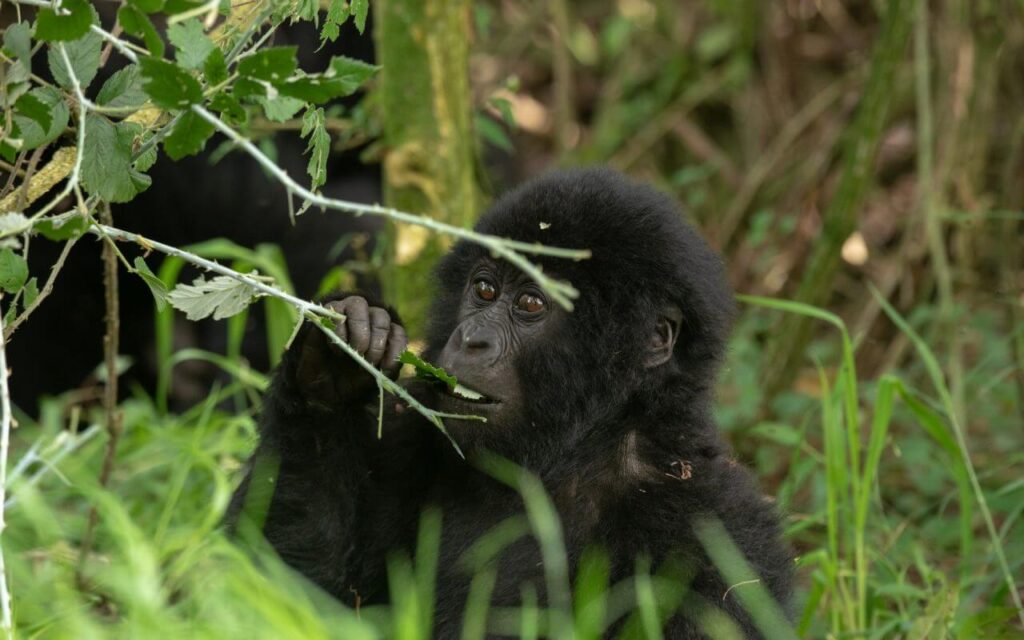
Subspecies Spotlight: Who Eats What?
The dietary habits of gorillas are heavily shaped by their environment. The four distinct gorilla subspecies live in vastly different altitudes and forest types, resulting in unique culinary preferences.
- Mountain Gorillas (The Foliage Specialists)
Living high in the cloud forests of the Virunga Volcanoes and Bwindi Impenetrable National Park, mountain gorillas endure cold temperatures and high altitudes.
- The Menu: Their habitat lacks fruit-bearing trees. Consequently, mountain gorillas are almost strictly folivores. Around 86% of their diet consists of leaves, shoots, and stems. Edible roots make up about 7%, flowers account for 3%, and fruit constitutes a measly 2%.
- Favorite Foods: They are incredibly fond of wild celery, thistles, nettles, and bamboo shoots.
- The Role of Bamboo: During the bamboo shooting season, mountain gorillas will descend to lower altitudes to gorge on these nutrient-rich, crunchy delicacies, which can cause mild intoxication if fermented.
- Eastern lowland gorillas (Gorilla beringei graueri)
Also known as Grauer’s Gorillas, these primates live in the diverse altitudes of the Democratic Republic of Congo (DRC).
- The Menu: Because their habitat spans both lowland and transitional forests, their diet shifts seasonally.
- The Shift: When fruit is abundant, it can make up a significant portion of their meals. When fruit is scarce, especially at higher elevations, they smoothly transition back to a heavy reliance on leaves, herbs, and bark.
- Western Lowland Gorillas (Gorilla gorilla gorilla)
The most numerous of all subspecies, western lowland gorillas inhabit the dense, tropical rainforests of Central Africa.
- The Menu: They are passionate frugivores. Fruit is the undisputed king of their diet, making up to 60% of what they eat when in season.
- Foraging Strategy: They track down more than 100 different species of seasonal fruits. When fruit yields drop during the dry season, they pivot to high-fiber foods like terrestrial herbs, soft tree bark, and roots to tie them over.
- Cross River Gorillas (Gorilla gorilla diehli)
Inhabiting the forested hills on the border of Nigeria and Cameroon, Cross River gorillas live in a highly fragmented landscape.
- The Menu: Similar to western lowland gorillas, they prefer fruit. However, due to the seasonal nature of their habitat, they spend long periods relying heavily on fleshy herbs, succulent stems, and a variety of forest leaves when fruit trees are bare.
The Carnivorous Exception: Do Gorillas Eat Meat?
While gorillas are overwhelmingly vegetarian, they are not strictly 100% vegan. They occasionally ingest small amounts of animal protein, though it is usually accidental or highly opportunistic.
- Insects and Grubs: Gorillas frequently consume ants, termites, and caterpillars. Western lowland gorillas, for example, will systematically break open termite mounds to feast on the larvae.
- Accidental Consumption: Because they consume dozens of pounds of leaves every day, they naturally swallow thousands of tiny insects, mites, and larvae clinging to the foliage.
- No Active Hunting: Unlike chimpanzees, which regularly hunt small monkeys or bushpigs for meat, gorillas do not hunt or consume meat from mammals. Their digestive systems are simply not built to handle a heavy meat-based diet.
Quantity and Calories: The Daily Feast
To maintain their massive muscle mass and generate enough body heat, gorillas must consume staggering amounts of food every single day.
- Adult Males (Silverbacks): An adult silverback can consume up to 45 to 60 pounds (20 to 27 kilograms) of vegetation in a single day. This is roughly equivalent to eating 100 to 130 heads of lettuce.
- Adult Females: Females are smaller, usually weighing half as much as silverbacks, and consume about 30 to 35 pounds (14 to 16 kilograms) of food daily.
Do Gorillas Drink Water?
- If you watch gorillas in the wild, you will rarely ever see them stop to drink directly from a river, stream, or waterhole. This behavior initially puzzled early researchers, but the explanation is quite simple: they don’t need to.
- The lush, succulent vegetation that forms the baseline of their diet consists of roughly 50% internal water weight. Combined with the thick morning dew that accumulates on forest leaves, gorillas absorb almost all of their necessary daily hydration directly through their meals. They only drink surface water on rare occasions if they are suffering from an illness or experiencing an unusually prolonged dry season.
The Myth of the Banana
Pop culture and cartoons have deeply ingrained the idea that all primates love bananas. However, this is largely a myth when applied to wild populations.
Wild gorillas rarely ever encounter domesticated yellow bananas. If a silverback happens upon a wild banana tree in its forest habitat, it doesn’t look for the fruit.
Instead, it will use its immense physical strength to tear the entire tree apart to reach the soft, watery interior pith of the trunk.
Evolutionary Engineering: How Gorillas Process Fiber
If a human attempted to eat 50 pounds of raw leaves and twigs, our digestive system would fail to extract any real nutrition, resulting in severe illness. Gorillas manage this feat thanks to specialized evolutionary adaptations.
The Gorilla “Beer Belly”
When looking at a gorilla, you will notice they have a notably large, distended abdomen. This is not fat; it is a massive, highly efficient digestive vat.
Gorillas have an elongated colon and a large cecum packed with specialized symbiotic bacteria. These bacteria break down cellulose—the tough, fibrous walls of plant cells—through a process of hindgut fermentation.
This fermentation converts tough fiber into volatile fatty acids, which provide the gorilla with a steady stream of energy.
Massive Jaws and Specialized Teeth
Chewing through tough bark, fibrous celery, and woody roots requires incredible physical strength.
Gorillas possess massive jaw muscles anchored to a bony ridge on top of their skull called a sagittal crest (most prominent in silverbacks).
Their teeth feature elongated canines used for display and defense, but their molars are broad and flat with high cusps, perfectly designed for grinding and pulverizing tough plant fibers before swallowing.
What do Gorillas Eat? Foraging Behavior and Social Structure
Food dictates almost every aspect of a gorilla’s daily routine and social structure. Gorillas live in tight-knit family groups led by a dominant silverback.
- The Daily Routine: A typical day is divided into distinct periods of foraging, traveling, and resting. They wake up at dawn and begin feeding immediately. By midday, they take a long siesta to rest, socialize, and allow their bodies to ferment the massive influx of fiber. In the afternoon, they forage once more before constructing fresh nests on the ground or in trees for the night.
- Nomadic Lifestyle: Because they eat so much, a troop cannot stay in one place for long without exhausting the local food supply. They move steadily through the forest each day, clearing away undergrowth but leaving enough roots and seeds behind for the vegetation to regenerate quickly.
- Tool Use: Gorillas are highly intelligent foragers. Western lowland gorillas have been observed using sticks to test the depth of muddy swamps before entering them to harvest aquatic herbs. Others use rocks to crack open hard nuts or seeds to access the nutrient-rich interiors.
Why Understanding the Gorilla Diet Matters
Studying what gorillas eat is not just a matter of biological curiosity; it is a critical tool for their survival.
All gorilla subspecies are currently classified as Endangered or Critically Endangered. Habitat destruction caused by logging, agriculture, and human encroachment directly threatens their food security.
When tropical forests are fragmented, western lowland gorillas lose access to the seasonal fruit trees they rely on, forcing them into closer contact—and conflict—with human agricultural zones.
Furthermore, understanding their exact dietary needs allows conservationists to better protect critical forest corridors and ensures that gorillas cared for in wildlife sanctuaries receive the precise balance of fiber, nutrients, and vitamins required to thrive.
The health of the gorilla is intrinsically bound to the health and diversity of the African forest.
Foraging Etiquette and Forest Conservation
Gorillas are highly intelligent and surprisingly sustainable eaters. They practice selective harvesting, meaning they never overexploit a single area.
A troop will move through the forest, taking a few leaves from one plant, a root from another, and a shoot from a third before moving along. This nomadic grazing pattern allows the cropped vegetation to quickly replenish and regenerate.
Furthermore, gorillas act as the vital “gardeners of the rainforest.” Because lowland gorillas consume so much fruit, they swallow large seeds whole.
As they travel across their expansive home ranges, they disperse these seeds across the forest floor through their nutrient-rich dung.
This process is absolutely essential for the genetic diversity and natural replanting of the African tropical rainforest ecosystem.
Last Thoughts on What do Gorillas Eat?
The gorilla’s diet is a masterclass in evolutionary adaptation. By processing massive quantities of fibrous vegetation through a specialized gut, these gentle giants have found a way to thrive as heavy weights without ever needing to hunt prey.
However, this highly specialized diet is also their greatest vulnerability.
Because they rely on such a vast quantity and variety of specific forest plants to survive, the destruction of African rainforests via logging, agriculture, and human encroachment poses an existential threat to their survival.
Protecting the rich plant life of the Congo Basin and East African highlands is not just about saving trees—it is about ensuring the world’s largest primates have enough to eat.