
Big Cat Safaris in Queen Elizabeth National Park -Ultimate Guide
Embarking on big cat safaris in Queen Elizabeth National Park offers a unique opportunity for you to explore small and large cats.
Explore the ultimate guide to experiencing the best of big cat safari tours in Queen Elizabeth National Park, including ideal places, safari tips, best time, where to stay, getting there, and more.
This is Queen Elizabeth National Park (QENP), affectionately known as “Queens” by conservationists and safari veterans.
Spanning nearly 1,978 square kilometers in the western region of Uganda, this remarkable protected habitat stands out as a top-tier sanctuary for large felines on the African continent.
While neighboring countries offer classic game drives, QENP flips the script entirely.
Here, predators do not merely rule the open plains; they sleep in the branches of ancient fig trees, navigate dense tropical forests, and pass freely between international borders.
For anyone seeking a deep, visceral, and authentic big cat encounter, a safari in Queen Elizabeth National Park is the ultimate pilgrimage.
The Feline Dynasty of Queen Elizabeth National Park
While the park is famously home to over 95 mammal species including massive herds of elephants and Cape buffaloes; it is the apex predators that command absolute attention.
The feline population is anchored by two flagship species: the African lion (Panthera leo) and the African leopard (Panthera pardus).
Big Cat Quick Profile
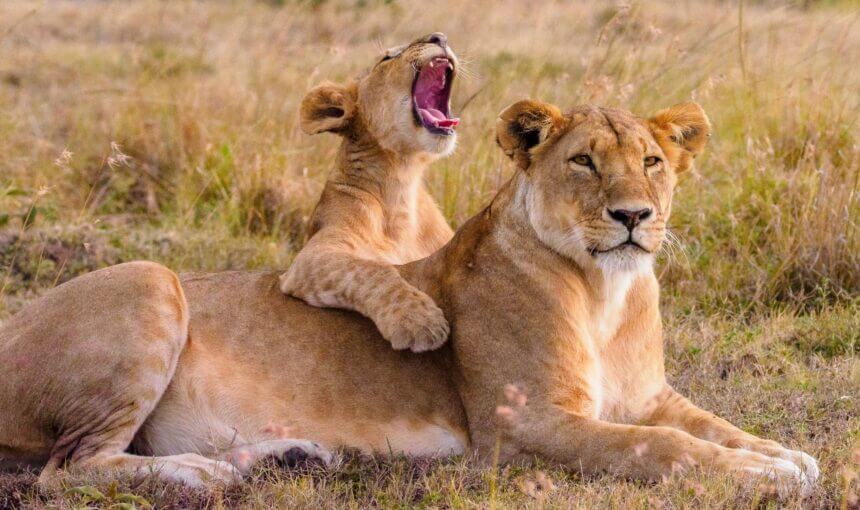
Lions dominate the sociopolitical landscape of the savannah. Operating in loosely structured prides of 5 to 20 animals, these magnificent carnivores thrive on the park’s dense populations of herbivores.
The females form the collaborative backbone of the pride, working in flawless tactical synchrony to bring down formidable prey like buffaloes or swift Uganda Kobs.
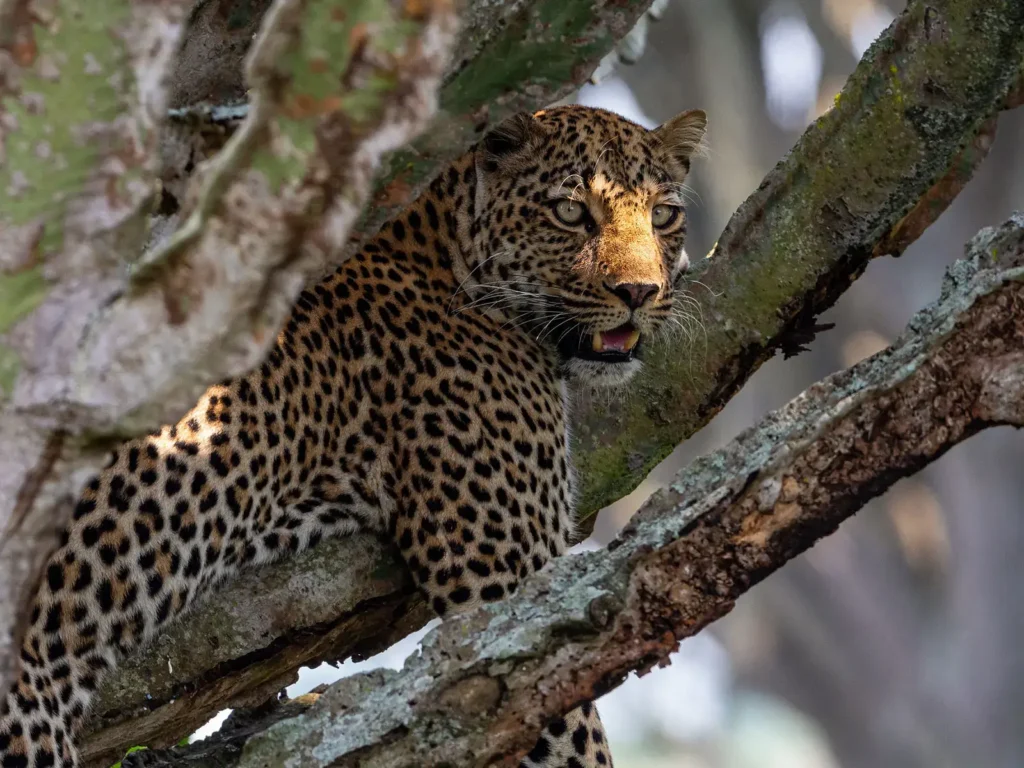
Leopards, by contrast, are the enigmatic ghosts of the park. Solitary, exceptionally powerful, and masterfully camouflaged, they represent the ultimate prize for wildlife trackers. Unlike the lions, who confidently sleep in plain sight,
Leopards rest during the day in dense bushes or tree branches, and they pull their heavy prey up into the trees to hide it from hyenas.
The Hotspots for Big Cat Safaris in Queen Elizabeth National Park
Queen Elizabeth National Park’s unique value lies in its sheer ecological diversity.
Five distinct types of vegetation—savannah grassland, forest grassland, acacia woodland, swampland, and Lakeland—create highly specialized hunting territories for the park’s felines.
-
The Kasenyi Plains: The ultimate Lion territory
Located in the northern sector of the park, the Kasenyi Plains are synonymous with classic lion country. These vast, sun-bleached grasslands are the primary breeding grounds for the Uganda Kob.
Because thousands of Kobs congregate here, the local lion prides rarely wander far from this massive, self-replenishing buffet.
Game drives here at dawn provide prime opportunities to witness the raw theater of predator-prey dynamics, from tactical ambushes to the triumphant sharing of a kill.
-
The Ishasha Sector: Home to the tree-climbing lions
In the far southern reaches of the park lies Ishasha, a remote and less-crowded wilderness that borders the Democratic Republic of Congo. Ishasha is globally legendary for its tree-climbing lions.
In contrast to the typical terrestrial lifestyle of African lions, the unique prides inhabiting the Ishasha sector have established a distinctive behavioral tradition of ascending giant sycamore figs and acacia trees.
Why the lions climb trees:
Scientists and guides have proposed several theories for this unusual behavioral adaptation:
First, climbing into the canopy provides a higher vantage point, allowing the lions to scan the horizon for potential prey.
Second, the elevated branches offer relief from the intense midday heat and provide excellent ventilation.
Thirdly, it keeps the lions well above the reach of ground-level irritants like tsetse flies and other pesky insects.
Finally, Thermoregulation where the elevated branches provide a cool breeze and shade, helping the big cats escape the intense daytime heat of the savannah floor.
For travellers, a drive through Ishasha is a thrilling treasure hunt.
Visitors scan the wide branches of the fig trees to spot a twitching tail, a dangling paw, or an entire pride sleeping comfortably above the ground.
The Ishasha region offers a quiet, exclusive atmosphere, making an encounter with these tree-dwelling cats a peaceful and memorable highlight.
-
The Mweya Peninsula and Maramagambo Forest: Leopard Domains
While lions often steal the spotlight, Queen Elizabeth National Park is also home to a healthy but elusive population of leopards.
These solitary, nocturnal cats are the undisputed masters of camouflage, utilizing the thick vegetation, dense scrub, and riverine forests to remain practically invisible during the day.
Because leopards hide so well, finding one on a safari requires a sharp eye and much waiting, making it the ultimate goal for travelers.
To maximize your chances of seeing one, experienced guides often focus their attention around the densely wooded areas of the Mweya Peninsula;
A finger of land extending into the water and the fringes of Maramagambo forest are exceptional spots for tracking these secretive predators.
Leopards are famous for hunting at dusk or at night, and they frequently haul their heavy kills such as antelopes, monkeys, birds, a young Uganda Kob high up into the branches of trees.
This clever tactic prevents ground predators, such as spotted hyenas and lions, from stealing their hard-earned meals.
If you spot a motionless, heavy carcass hanging strangely in a tree, keep your binoculars handy, a leopard is likely resting nearby
Enhancing the Encounter: Experiential Tracking and Night Drives
Standard game drives are incredible, but Queen Elizabeth National Park offers specialized experiences that bring you closer to the world of big cats than almost anywhere else in East Africa.
Scientific Lion Tracking Research
For an immersive dive into conservation, visitors can participate in a lion tracking research experience managed by the Uganda Carnivore Program (UCP).
Guided by seasoned field scientists, you venture deep into the untamed grasslands, tracking signal frequencies from fitted radio collars to pinpoint specific wildlife.
Lion tracking activity isn’t just about viewing; it allows you to learn about pride dynamics, home ranges, and the complex human-wildlife conflicts facing the park’s carnivores.
Nocturnal Night Drives
The park also grants permits for night game drives, accompanied by armed rangers and powerful spotlights.
As the sun sets, the savannah undergoes a complete shift. This is when the true behavior of nocturnal cats comes alive.
Under the cover of darkness, you can listen for the saw-like rasp of a leopard, look for the reflective eyes of serval or civet cats, and watch lions actively preparing for night hunts.
The Best Time to Visit
While you can visit Queen Elizabeth National Park at any time, picking the right season is crucial for the best big cat sightings.
The months of June through September, along with the period from December to February, bring dry weather.
This phase offers the absolute best chance to spot big hunters in action.
As water holes dry up, herbivores congregate predictable around the Kazinga Channel and permanent water points, drawing big cats out into the open.
Furthermore, the savannah grasses are low, making the camouflaged coats of leopards and lions much easier to spot.
The Wet Seasons (March to May & October to November):
While the roads can be muddy, the park transforms into an emerald paradise.
Migratory birds flood the area, and newborn antelopes appear, triggering burst of high-stakes predator activity.
Lodges also frequently offer off-season discounts during these months.
How to Get There
The park sits roughly 400 to 470 kilometres west of Kampala and Entebbe.
- By Road: A standard overland journey takes between 6 to 8 hours. Travelers can take the scenic southern route via Masaka, Mbarara, and Bushenyi, or navigate the northern route through Mubende, Fort Portal, and Kasese. A rugged 4×4 safari vehicle is highly recommended to comfortably navigate the park’s internal dirt tracks.
- By Air: For those looking to maximize their time in the wild, domestic flight operators run daily scheduled and charter flights from Entebbe International Airport or Kajjansi Airfield. Flights land directly at internal airstrips such as Mweya, Kasese, or Kihihi (near Ishasha), reducing travel time to just over an hour.
Safari Etiquette and Safety in Cat Country
To preserve the wild integrity of Queen Elizabeth National Park and ensure an optimal experience, the Uganda Wildlife Authority (UWA) enforces clear codes of conduct:
- Observe the Speed Limit: Vehicles must maintain a maximum speed of 45 km/h to prevent accidental collisions with wildlife crossing the tracks.
- No Hooting or Loud Noise: Predators rely heavily on their acute hearing. Loud noises or car horns can disrupt hunts or cause animals to flee into deep brush.
- Stay in Your Vehicle: Unless you are at a designated picnic site, crater viewpoint, or accompanied by an armed ranger on a walking safari, always remain inside your safari vehicle.
- Keep a Respectful Distance: While getting close is a thrill, crowding a big cat especially a mother with cubs or a leopard on a kill can induce severe stress and defensive aggression.
Beyond the Big Cats
While the lions and leopards are undoubtedly the stars of the show, a big cat safari in QENP easily blends into a multi-dimensional African adventure.
Between your morning and evening predator drives, you can embark on a boat cruise along the world-famous Kazinga Channel to witness thousands of hippos, elephants, and crocodiles bathing in the afternoon sun.
Alternatively, you can trek into the dramatic underground rainforest of the Kyambura Gorge to track habituated wild chimpanzees.
This makes Queen Elizabeth Safari Park one of the rare places on earth where you can watch a lion track the plains in the morning and hear a chimpanzee scream from the canopy by afternoon.
Where to Stay on Big Cat Safaris in Queen Elizabeth National Park
Queen Elizabeth National Park offers excellent lodging options that place you right in the heart of big cat territory.
- Ishasha Wilderness Camp: Located directly inside the southern sector along the banks of the Ntungwe River, Ishasha Wilderness Camp offers high-end luxury canvas tents. It is the perfect home base for quick, direct access to the famous tree-climbing lion circuits.
- Mweya Safari Lodge: Situated on a raised peninsula in the northern sector, this classic lodge offers panoramic views of the Kazinga Channel and the Rwenzori Mountains. It provides central access for morning drives into Kasenyi and afternoon boat safaris.
- Kasara & Katara Lodges: Nestled on the dramatic rift valley escarpments just outside the park gates, these lodges offer sweeping views over the savannah plains. They are excellent choices for travelers who value spectacular photography and landscape views.
Preserving the Wild Felines
The big cats of Queen Elizabeth National Park face modern conservation pressures.
Enclave fishing communities and growing human settlements along the park borders can lead to human-wildlife conflict, particularly when predators wander near livestock.
Every visitor playing a part in responsible tourism directly funds the Uganda Wildlife Authority (UWA) and the Uganda Carnivore Program.
By paying park entry fees, hiring licensed local guides, and participating in authorized tracking experiences, travelers provide the financial incentives required to protect these animals and support community-led conservation.
A big cat safari here is more than just checking items off a wildlife list.
It is an opportunity to immerse yourself in one of Africa’s most dynamic ecosystems, witnessing the raw beauty, power, and fragile survival of the continent’s grandest felines.
Book Big Cat Safaris in Queen Elizabeth National Park today with Vizuri Africa Safaris